Wildfire smoke can disrupt youth sports hundreds of miles from an active fire. During July 2026, smoke affected parts of the Great Lakes and Northeast as well as areas closer to fires, underscoring how quickly air-quality concerns can cross regional boundaries.
The operational challenge is not simply deciding whether to cancel. Program leaders must determine who is responsible, which information to trust, when to check it, what adjustments are available, and how families will hear about changes.
A written youth sports AQI protocol turns those questions into a repeatable process. It does not eliminate judgment, but it helps coaches and administrators make that judgment consistently and within applicable local rules.
Why smoke decisions require advance planning
Children can be more vulnerable to wildfire smoke, particularly when they have asthma or another chronic health condition. Vigorous activity also increases the amount of air a participant inhales. A normal training session may therefore create greater exposure than quiet outdoor activity under the same conditions.
Conditions can also shift during a practice or competition. An acceptable reading from earlier in the day is not necessarily sufficient for an evening event.
Satellite imagery adds context but should not be treated as a substitute for ground-level information. Smoke visible overhead may be higher in the atmosphere rather than near the surface. Programs need information that reflects current PM2.5 conditions near the venue.
Assign authority before the first smoke day
Every protocol should name a primary decision-maker and a backup. Titles matter less than clarity.
The plan should answer four questions:
- Who checks the forecast and current conditions?
- Who can modify, relocate, delay, stop, or cancel an activity?
- Who coordinates with officials, opponents, facilities, transportation staff, and administrators?
- Who sends updates to coaches and families?
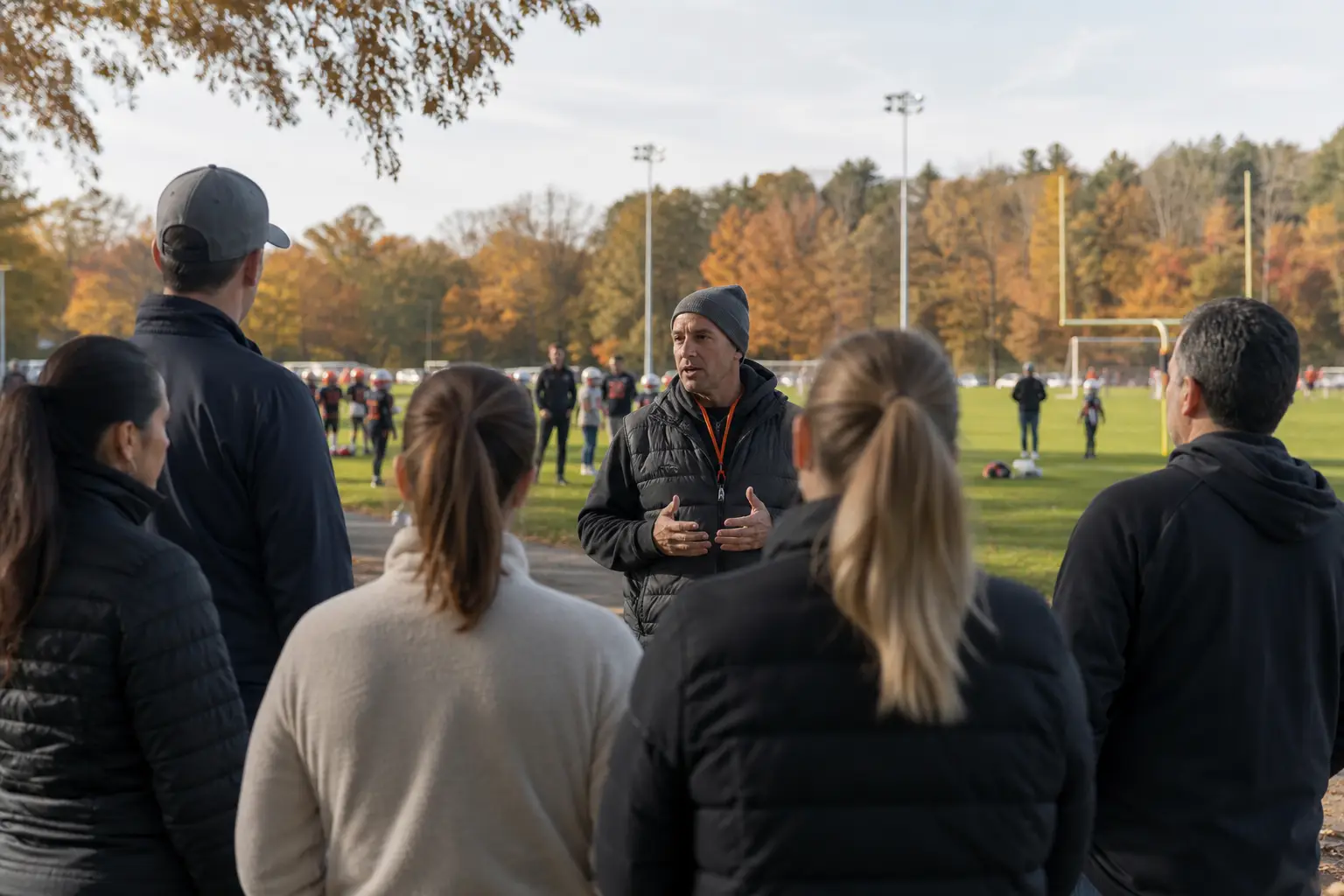
A coach at the field should also know whether they may stop activity when conditions deteriorate or participants report symptoms. Requiring a long approval chain can delay a necessary operational response.
Programs using shared administrative resources can place the completed protocol in a central location such as a staff drive or coach portal. The important point is that the current version remains accessible from the field.
Use planning information and real-time readings
The Environmental Protection Agency distinguishes between AQI forecasts used for planning and current information based on recent conditions. Both have a role.
Earlier in the day
Review the AQI forecast and anticipated smoke movement. This check can trigger preliminary conversations with facilities, opponents, transportation providers, and families. It also gives the program time to evaluate indoor space rather than searching for an alternative shortly before practice.
Before and during the event
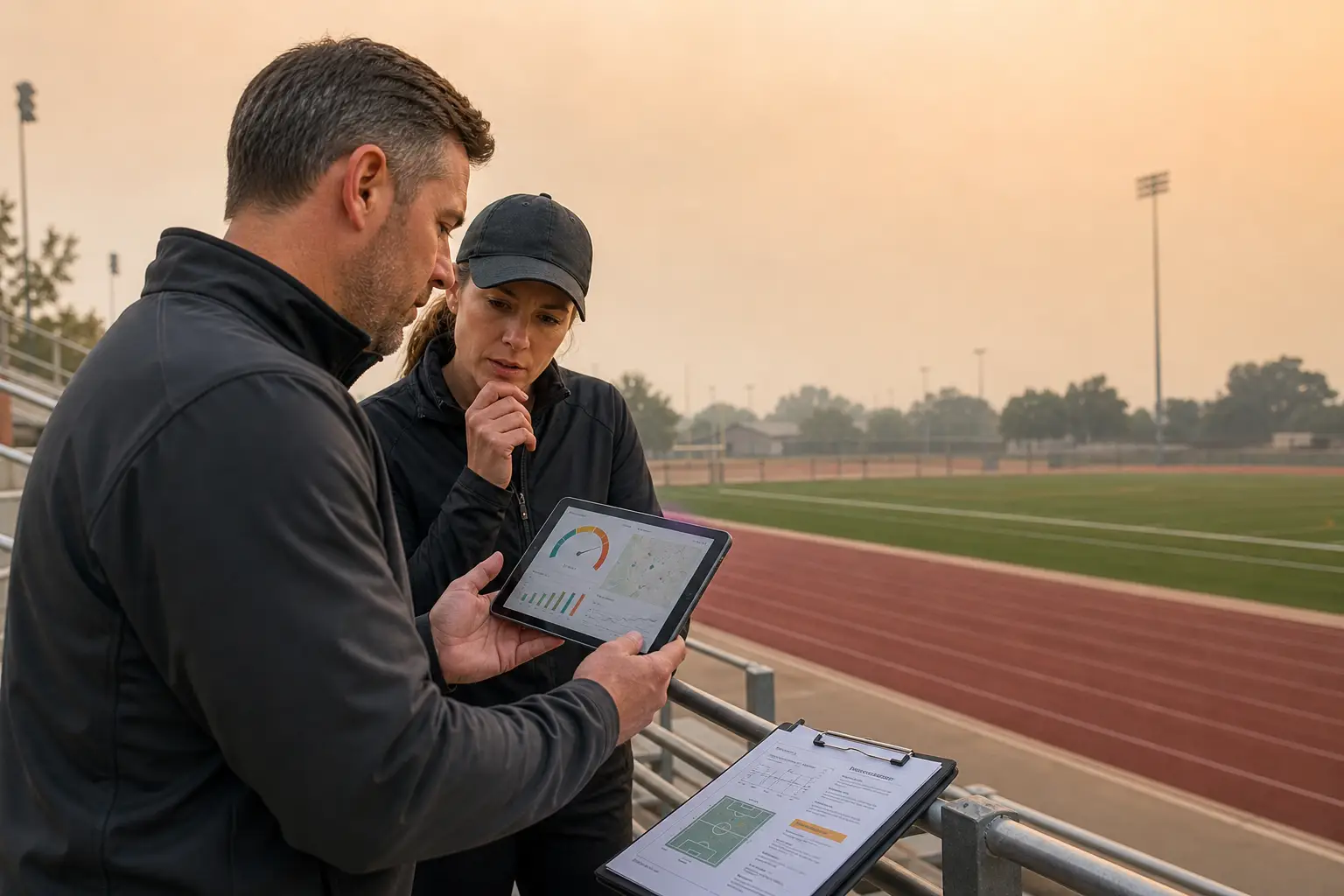
Use the AirNow Fire and Smoke Map to examine current PM2.5 conditions near the venue. Record the source, location, reading, and check time. Recheck at predetermined intervals when smoke is present or conditions are changing.
The protocol should say what happens if the nearest monitor is not directly at the field. Local governing guidance may explain which available reading to use. The Oregon School Activities Association guidelines, for example, demonstrate how one governing body assigns monitoring responsibility and connects readings with operational actions. They are an example, not a nationwide standard.
Build an action ladder around local requirements
A useful protocol defines progressively stronger responses instead of presenting cancellation as the only available decision. The AirNow school activity guidance provides a framework for considering activity intensity and duration across AQI conditions.
A program’s ladder might include:
- Proceed normally: Conduct the activity while maintaining routine observation.
- Increase observation: Recheck conditions more frequently and brief coaches on possible changes.
- Reduce exposure: Lower exertion, shorten the session, add recovery periods, or remove optional conditioning.
- Relocate or reschedule: Move to a verified indoor location, change the time, or postpone the activity.
- Cancel or stop: End the event and activate transportation, pickup, and notification procedures.
Do not copy another state’s numerical triggers without checking your own obligations. Exact action points should align with the applicable state athletic association, school district, league, facility, and local public-health requirements. If multiple policies apply, administrators should resolve conflicts before the season.
A practical decision example
Suppose an afternoon forecast indicates possible smoke for a 6 p.m. practice. The designated manager alerts the indoor facility and sends families a preliminary notice. A current check before departure shows worsening conditions, activating the relocation level in the program’s locally approved ladder.
The manager confirms that the indoor space is usable, records the reading and time, and sends the final location and pickup instructions. The coach continues monitoring under the indoor-air portion of the protocol. This sequence is more consistent than waiting for families to arrive and debating the options at the field.
Create a sensitive-participant procedure
Families should be reminded before the season to follow any existing clinician-provided asthma or health action plan. Participants also need a straightforward way to report symptoms, reduce participation, or sit out without pressure.
Coaches should not attempt to diagnose or treat a participant. If someone develops symptoms, staff should stop the person’s exposure and follow the program’s established emergency procedures. The CDC’s guidance on wildfire smoke and children provides further context for families and program leaders.
Verify that an indoor alternative is actually safer
Moving indoors is not automatically a solution because outdoor smoke can enter buildings. An indoor option should be evaluated before it appears on the backup list.
Identify who can confirm the building’s status, how smoke intrusion is limited, whether filtration has been assessed, and whether indoor PM2.5 can be monitored where feasible. The EPA’s indoor air-quality guidance for schools and commercial buildings addresses HVAC preparation, filtration, cleaner-air spaces, and monitoring.
If the program cannot verify that a backup venue is appropriate, the action ladder should direct leaders toward rescheduling or cancellation rather than assuming that any gym will work.
Use a standard family message
Prepare a reusable message before the season. Each update should state:
- The decision: proceed, modify, relocate, delay, reschedule, or cancel.
- The AQI information source and check time.
- The operational change, including location or schedule details.
- The time of the next update, if the decision remains provisional.
- Transportation, supervision, or pickup instructions.
Families should receive the overall decision process during preseason onboarding. That makes a smoke-day message easier to understand and reduces confusion about why a change was made.
One-page AQI protocol worksheet
Program leaders can copy the following fields into a shared document, complete them with local authorities, and save or print the result as a one-page field reference.
- Applicable rules: State association, district, league, facility, and public-health requirements.
- Information sources: Forecast source, current-condition source, preferred monitor, and fallback source.
- Check schedule: Planning check, pre-event check, arrival check, and in-event recheck interval.
- Responsible personnel: Primary decision-maker, backup, on-site authority, and communications lead.
- Action levels: Local triggers for normal activity, observation, reduced exposure, relocation, postponement, and cancellation.
- Backup locations: Address, contact, availability process, filtration information, and indoor-condition checker.
- Notification channels: Team app, email, text, website, phone tree, and officials’ contacts.
- Emergency information: Venue procedures, emergency contacts, participant action-plan process, and pickup plan.
- Decision record: Reading, source, location, time, action, decision-maker, and message time.
After each disruption, review whether notifications were timely, the backup venue was genuinely usable, and every person understood their role. Update the worksheet while the experience is still fresh.
The goal is not to predict every smoke event. It is to establish a consistent, locally compliant process that can keep pace as conditions change.
Sources & Further Reading
- Air Quality and Outdoor Activity Guidance for Schools — AirNow
- Using the Air Quality Index to Plan Daily Activities — EPA
- Wildfire Smoke and Children — CDC
- Wildfires and Indoor Air Quality in Schools and Commercial Buildings — EPA
- 2026-27 Air Quality Guidelines — Oregon School Activities Association
- Active Wildfires Test Smoke Models — NOAA Global Systems Laboratory