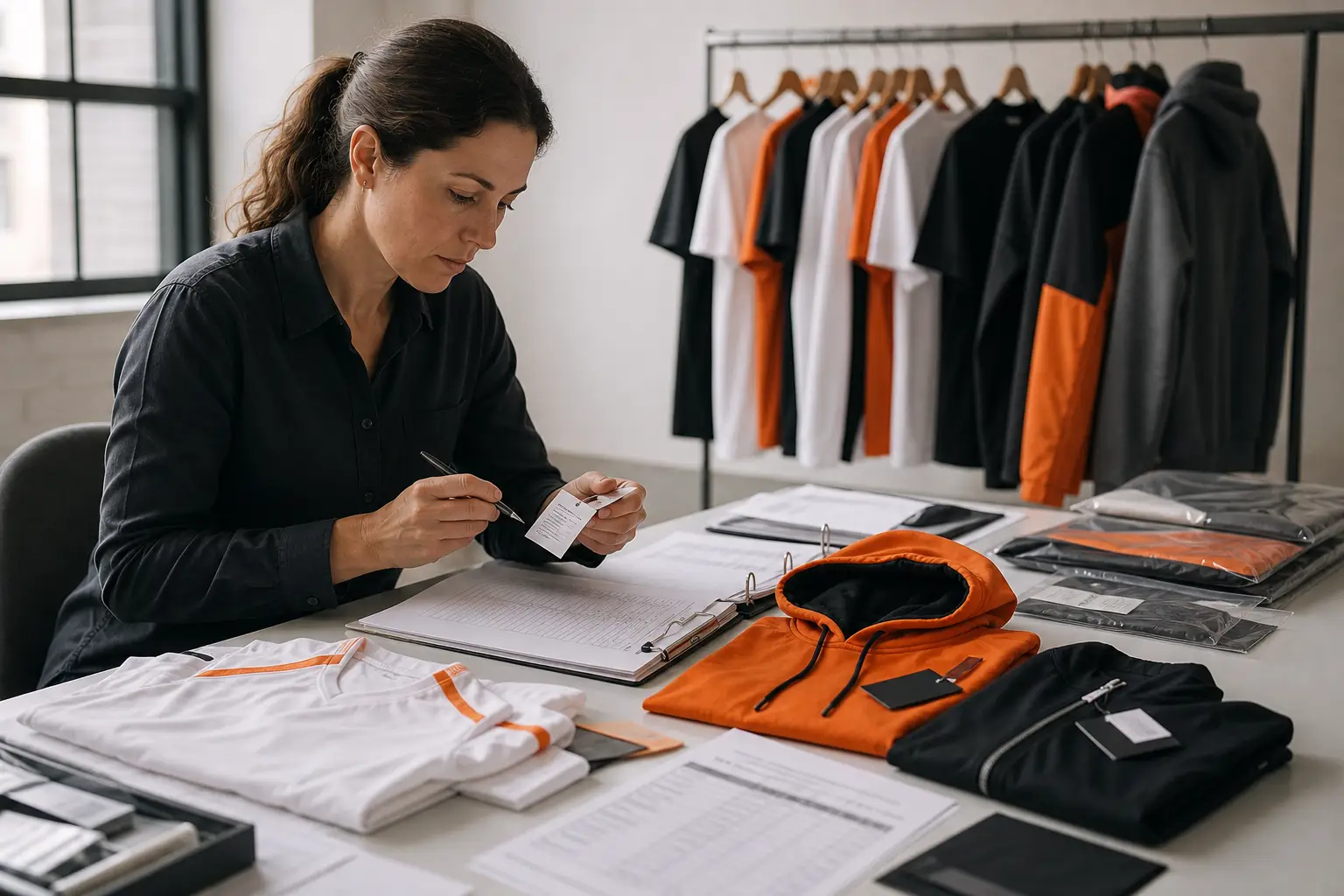
A team should not have to reconstruct its uniform from memory whenever a replacement, late-player addition, or future-season reorder is needed.
Critical information often remains scattered across emails, photographs, invoices, staff computers, and the recollections of one coach or administrator. An old jersey may show the general appearance, but it rarely identifies every garment, artwork, color, decoration, label, and approval detail needed for an accurate reorder.
A team uniform master file creates one controlled record for each uniform set. September 2026 is a practical checkpoint for fall programs because issued garments are still available to inspect while sizing gaps and roster needs are becoming visible.
Visual Design and Production Specifications Are Different
The visual design describes the intended appearance: colors, logos, typography, numbers, names, and their arrangement.
The production specification explains how to reproduce that appearance on a particular garment. It includes the garment reference, cut, labeled size, fabric information, artwork files, color targets, decoration method, dimensions, placement, labels, and approved proof.
A photograph cannot provide every production detail. Perspective may distort placement, lighting can change the apparent color, and an image may not reveal the decoration method. A physical jersey also may not identify the source artwork or later revisions. The master file should preserve both the design and its production specification.
The 12-Field Team Uniform Master File
Use this checklist for every uniform set. A spreadsheet, controlled document system, or shared database can work if naming, access, and revision practices remain consistent.
- Permanent uniform-set ID. Assign a stable internal code to the complete set. Record the program, sport, team level, home or away designation, season introduced, file owner, and current status. Do not reuse the ID after retiring the design.
- Variant and garment IDs. Identify each garment type, cut or fit, color, and labeled size separately. A medium home jersey and a large home jersey are distinct inventory items. This adapts the variation-identification principle found in GS1 US apparel guidance without suggesting that teams need commercial product identifiers.
- Exact garment specification. Record the approved style reference, product description, size range, cut or fit, base color, and distinguishing construction details. Avoid entries such as “navy home jersey.” Treat an unavailable garment or proposed substitute as a documented change, not as an identical item.
- Label and care record. Photograph every label and record its fiber content, country of origin, responsible company identification, labeled size, care instructions, and warnings. The Federal Trade Commission provides guidance on textile labeling information and care-label instructions. Do not assume that similar-looking garments have identical care requirements.
- Master artwork and approved proof. Retain editable vector source files for logos and graphics, along with a read-only PDF proof of the approved appearance. Record filenames, versions, approval dates, and whether lettering was converted to outlines. Preserve legitimately licensed font information needed for future edits. Adobe’s vector-artwork overview identifies AI, SVG, and PDF as relevant formats.
- Color standards and physical references. Record separate targets for fabric, printed graphics, embroidery, transfers, and other decoration. Use recognized references where available, but do not treat a monitor or screenshot as a physical production standard. Color can vary across materials and processes, as explained in Pantone’s color-system guidance. Retain an approved garment or swatch when practical.
- Decoration map. Create front, back, and relevant side views. For each element, identify the artwork version, approximate location, finished dimensions, alignment point, and decoration method. Photograph the approved garment beside a ruler or measurement reference, and state whether each measurement describes graphic size, seam distance, or center-point placement.
- Variable names and numbers. Define the player-name format, capitalization, number style, number range, dimensions, and placement. State how long names, punctuation, duplicate numbers, captain marks, and staff garments will be handled. Keep the approved roster data in a controlled order sheet and verify every variable entry before production.
- Rules and competition context. Record the sport, governing body, state association where applicable, competition level, and rules season checked. Requirements may change between sports or seasons. The 2026-27 NFHS soccer interpretations and 2026-27 NFHS volleyball materials illustrate why an old approval should not automatically be treated as current.
- Approval and revision history. Record the approver, approval date, proof version, approval method, and relevant comments. Log every later change to the garment, sponsor mark, logo, color, number style, decoration, or rules requirement. Never overwrite an earlier approved record; mark it superseded and link it to the replacement.
- Issue and inventory record. Track player or staff assignment, garment ID, labeled size, quantity, condition, issue date, return status, and replacement reason. Use the same garment and variant IDs found in the production record. Keep medical details and other unnecessary sensitive information outside the uniform file.
- Reorder check and file ownership. Identify the staff role responsible for the file and include a repeatable preproduction review. Confirm current rules, compare the new proof with the master record, check names and numbers, document unavailable components or substitutions, and obtain written approval before production. Record the next review date and archive location.
Why an Old Jersey Is Not Enough
Suppose a program needs one replacement jersey. A photograph shows a dark blue body, white number, and chest logo, but it does not confirm the exact garment, fit, artwork version, logo width, number style, decoration method, care instructions, or current rules status.
If the original garment is unavailable, assign the proposed replacement a new variant ID. Compare it with the retained sample, document the differences, approve a revised proof, and preserve the previous specification rather than rewriting the record.
Use a Short Reorder Verification Procedure
- Confirm the applicable rules and competition season.
- Compare the proposed proof with the current master record.
- Verify every variable name and number.
- Document any unavailable garment, color, decoration, or other component.
- Record proposed substitutions as revisions.
- Obtain written approval before production.
This procedure creates a clear checkpoint between an earlier approval and a new production request.
Review and Archive the File Annually
Review every active master file at least once a year. Confirm that source artwork still opens, retained samples are labeled, permissions remain accessible, and current staff know which role owns the record.
Retire obsolete specifications without deleting them. Photograph retained reference garments, record their storage locations, and distinguish active, superseded, and archived versions. This preserves institutional knowledge when coaches, administrators, dealers, or suppliers change.
Actionable Takeaway
Select one issued uniform set and build its 12-field record while the garments and approvals are easy to access. Start with its permanent ID, labels, artwork, approved proof, color reference, and measured decoration photographs.
Then assign responsibility to a staff role rather than relying only on one individual. Whether a program later uses a teamwear portal, a dealer, or another ordering process, the controlled record provides a clearer basis for verification.
Sources & Further Reading
- Federal Trade Commission: Textile and Wool Labeling Requirements
- Federal Trade Commission: Care Labeling Rule Guidance
- GS1 US: Apparel and General Merchandise
- Pantone: Color Systems Explained
- Pantone: Using Physical Color Samples
- Adobe: Logo Design and Vector Artwork
- NFHS: 2026-27 Soccer Rules Interpretations
- NFHS: Volleyball Rules and Uniform Resources