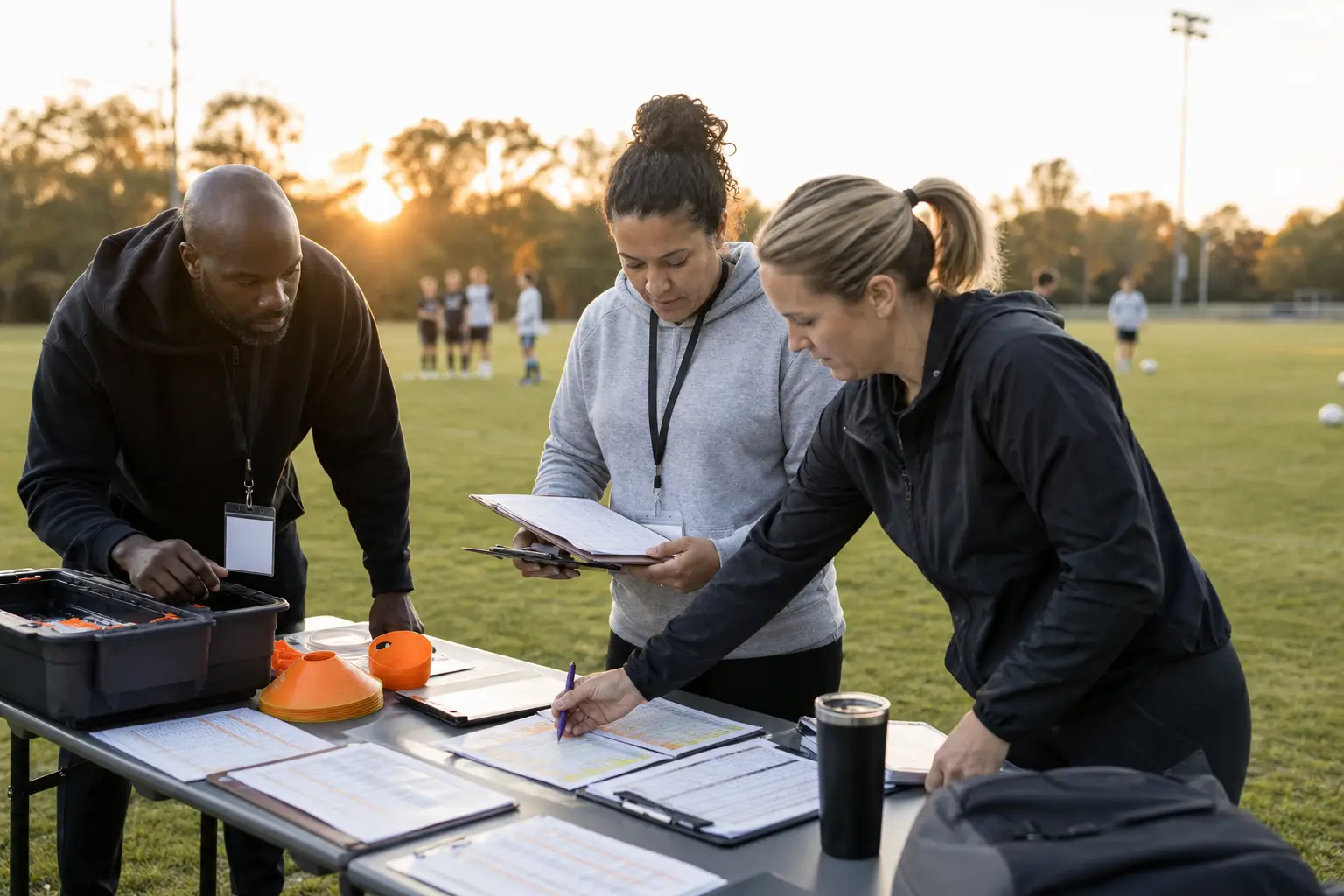
“We need more volunteers” may be accurate, but it is not a useful job description.
Families hearing that appeal must guess what the club needs, how long the commitment will last, whether they are qualified, and whether saying yes will lead to an indefinite obligation. Many will reasonably decide not to take the risk.
A parent volunteer role menu offers a better approach. It converts recurring operational work into specific, limited jobs that people can evaluate against their schedules and abilities. Instead of asking someone to “help with events,” a club might request a 45-minute check-in shift with written instructions, a named supervisor, and a clear finish.
This model reflects a broader change in volunteer availability. According to the U.S. Census Bureau, formal volunteering rebounded in 2023, but the average annual time contributed per formal volunteer declined from 96.5 hours in 2017 to 70 hours in 2023. Clubs should not assume that willing families can accept season-long or open-ended positions.
Start With a 20-Minute Workload Audit
The goal of a workload audit is not to document every task in the organization. It is to identify work that has quietly accumulated around coaches, directors, team managers, board members, and a small group of dependable parents.
Bring those people together for 20 minutes and ask three questions:
- What recurring tasks are you completing that do not require your specific role or expertise?
- What work is delayed, rushed, or completed outside normal program hours?
- What would cause a practice, game, or event to struggle if one key person were absent?
List the answers without immediately assigning them. Common bottlenecks may include field setup, attendance follow-up, schedule verification, event check-in, equipment inventory, photo-permission tracking, snack coordination, and end-of-day cleanup.
Then sort the list into three categories: work that can be delegated with basic instructions, work that requires additional access or safeguards, and work that must remain with staff or designated leaders.
Turn Each Task Into a Seven-Part Role Card
A role menu works only when each listing provides enough information for a family to make an informed decision. Every role card should contain seven fields.
- Outcome: State what successful completion makes possible.
- Exact duties: List the actions included—and, when useful, what is not included.
- Estimated time: Give a realistic range rather than calling the task “quick.”
- Location or remote option: Explain where the work happens and whether it can be completed off-site.
- Required training: Identify any orientation, system access, screening, or safety preparation.
- Supervisor: Name the role or person who answers questions and makes decisions.
- Completion handoff: Explain how the volunteer reports completion, returns materials, or flags a problem.
For example, “Saturday field setup” could become: arrive from 8:00 to 8:45 a.m.; place cones and signs according to a diagram; report damaged or missing items to the site manager; and send a completion message before leaving. The role card should also state whether lifting, outdoor work, or other physical activity is involved.
That is far easier to assess than “help with fields.” It also gives the club a repeatable process if a different person takes the assignment next week.
Offer More Than One Commitment Format
A useful menu accommodates different types of availability. Some parents can help on-site but cannot make a weekly commitment. Others may have limited event availability but can complete administrative work remotely.
Consider offering:
- One-time shifts: Event check-in, equipment counting, field setup, or cleanup.
- Rotating assignments: A responsibility shared across several families on a published schedule.
- Job-sharing: Two people divide one coordinator role by day, function, or team.
- Remote tasks: Schedule verification, attendance follow-up, spreadsheet updates, or permission-record checks, subject to privacy controls.
- Short projects: A specific assignment with a deliverable and end date, such as organizing an equipment list.
Whenever possible, divide work into 30- to 90-minute units. Not every responsibility will fit that range, but using it as a design target helps clubs question whether a large position is actually several smaller jobs bundled together.
Shared roles can also widen access to club service and leadership. A person who cannot accept an entire coordinator position may be able to manage one clearly defined part with a peer and a documented handoff.
Recruit for a Contribution, Not a Title
Volunteer messages should explain the task, its purpose, and its boundaries. Compare these two approaches:
Volunteers needed for Saturday. Please let us know if you can help.
We need two adults for 30-minute event check-in shifts Saturday morning. Volunteers will confirm names against a prepared list and direct families to the correct field. Instructions and materials will be provided by the event lead.
The second message gives families enough information to decide. It also shows why the work matters without exaggerating its importance.
Avoid unnecessary requirements. If a task does not require sports experience, say so. If it can be completed while seated or remotely, include that detail. If physical lifting or fluency with a particular system is genuinely necessary, state it transparently.
Separate Logistics From Athlete-Access Roles
Breaking work into smaller jobs does not reduce a club’s safeguarding responsibilities. Roles involving access to athletes, transportation, private communications, sensitive records, money, or organizational authority require a separate level of review.
Before filling those positions, apply the organization’s established screening, training, supervision, communication, and abuse-prevention policies. Clubs should also determine which rules apply based on their governing structure, jurisdiction, and relationship to relevant sport organizations.
The U.S. Center for SafeSport’s local club resources encourage organizations to consider prevention education, applicable policies, and available disciplinary information when making decisions about people who will interact with young athletes.
Do not present safety-sensitive assignments as casual favors. A volunteer should never gain access to athletes, private contact details, medical information, payment systems, or transportation duties simply because a last-minute gap appeared.
Support the Volunteer Through the Finish
Role clarity is a retention practice, not paperwork. Every volunteer should receive brief instructions, the necessary tools, a named contact, and a simple reporting method.
For a recurring role, create a short handoff note covering what was completed, what remains unresolved, and what the next person needs to know. Store reusable instructions where authorized leaders can find them rather than leaving the process in one volunteer’s text messages.
Check workloads during the season as well. Set limits on repeated assignments, identify backups for essential functions, and avoid automatically asking the most reliable parent every time. Concentrating work may feel efficient until that person becomes unavailable or burned out.
Recognition should be prompt and specific: thank the volunteer for the contribution they actually made and explain its effect. Then invite them to choose another listed opportunity. Do not treat successful completion of a small job as consent to a larger, indefinite responsibility.
A Practical September Reset
For fall programs, September is a useful point to inspect how work is distributed after opening-week plans meet operational reality.
Set aside 20 minutes for the audit, choose five delegable tasks, and create a seven-field role card for each. Publish a mix of on-site, remote, one-time, and rotating options. Review safety-sensitive roles separately before recruitment begins.
The central principle is simple: make the work visible, bounded, supported, and transferable. Families are more likely to consider helping when they know exactly what “yes” means—and clubs are better positioned to supervise that help responsibly.
Sources & Further Reading
- U.S. Census Bureau: Civic Engagement and Volunteerism
- Aspen Institute Project Play: State of Play 2025
- Australian Sports Commission: Volunteer Management
- Sport and Recreation Victoria: Volunteer Capacity of Community Sports Clubs
- Journal of Organizational Behavior: Predictors of Volunteer Turnover
- VolunteerMatch: Inclusive Volunteer Position Descriptions
- U.S. Center for SafeSport: Resources for Local Clubs